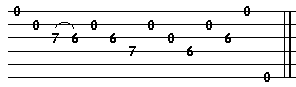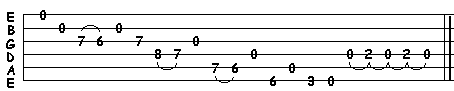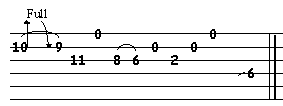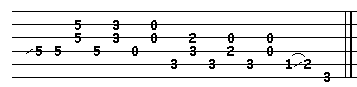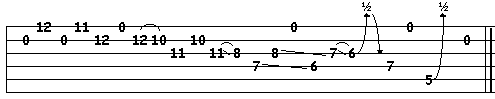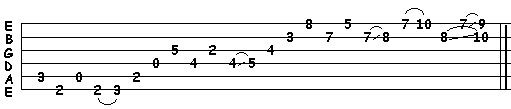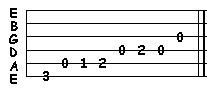
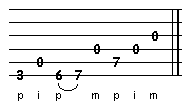
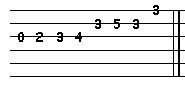
Here you´ll find a bunch of so called G-runs in different positions. Let´s begin with five in the key of, yes, G.
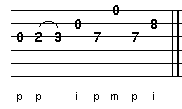

Three in C.


Two in D.

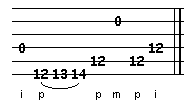
Two in A.
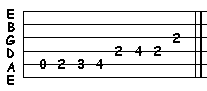
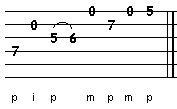
Two in E.
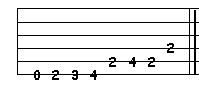
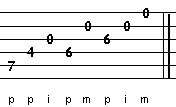
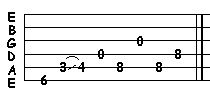
And finally, also to show the possibilities with open strings, here´s one in B flat.
=========================
Hot ending, reminds me of a banjo roll.
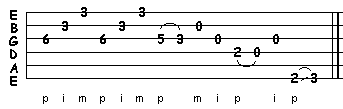
Down and up and down in G.
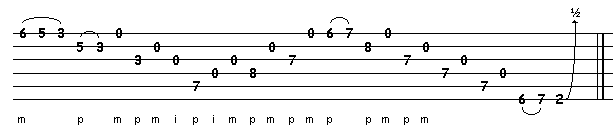
This thing sounds pretty good once the notes start flowing. All open strings should be played with either your index or your middle finger.

A G scale in the style of Chet Atkins.

Here you have three short but sweet licks in G.
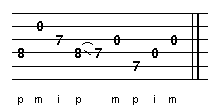
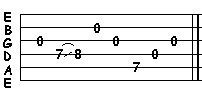
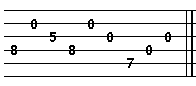
More open strings in G. My friend Joakim Skoglund showed me these two.
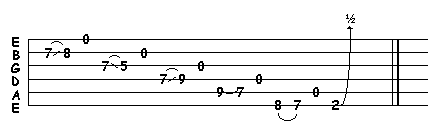
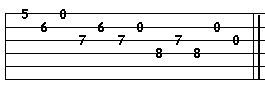
Here´s some dynamite stuff for your C collection.

==============================
Good for ending things in E.

Four more open string licks in E.
This G lick can be played at a very high tempo.
I´m not sure, but I think this is what is usually referred to as "double-stops".
Here´s one in B. As you might hear, I use a lot of palm muting. I always loved that... The bend on the A-string should be bent up towards the lower E to avoid muting of the D-string.
A personal favourite in the key of A.
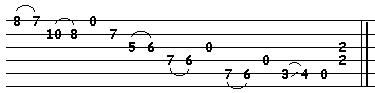
A typical rock ending, also in A.

==========================
Some chicken pickin´ following a presumptive A/E/A chord pattern.

Here´s an example of taking a fairly short lick and then repeating it in different octaves to make it longer. Key of A.
Nice ending in G (with one variation).
Pick it up! In C (or actually, C/F/C).
The next one in A is a bit on the swingin´ side.
A fast one in E.
Nice ending lick. Also in E.
A bit of twang in D.
This one should work fine as a dominant A(7).

A9(no 3rd) leading up to a clean A.

============================
Do you like the sound of bluegrass banjo? Well, here is my arrangement of a couple of classic banjo rolls for the guitar. But take it slow, this is not easy. The numbers indicate left hand fingerings(index=1).

And here´s a typical banjo ending lick.

Steel sound in the key of D. Use the volume knob for the
volume pedal effect.

Rock in B.
The next includes tapping and bending. The tapped note is also bent with the left hand.
You´ll probably recognize the melody in this little arrangement. Just to spice it up a bit.
Roll it on home! It´s actually a quite nice melody.
A nice ending for you finger pickers out there! In G.
=================================
Bends galore in D.

Easily transposable lick. Played and written in E.
A short A lick repeated in three octaves. Ends on a groovy A9.
A bit jazzy in E.

=========================
A G mixolydian (G7) open string scale. Watch the right hand fingering. When using a thumb pick runs like this one feel somehow natural.

A good ending in G starting with the above scale.
I have developed my ideas on getting that bluegrass banjo sound on guitar further and here are some examples of that. First a couple of typical endings.
If you get this thing rollin´ it´s great fun. Be sure to try it on an acoustic guitar with a capo up high.
Since we´re in E, this banjo lick should be played when you go to the dominant i e B(7). You´ll hear when to return to E.
A variation on the above. Ends with one of my infamous open string runs.
This one is very useful on an A/E/A pattern. I´ve included rhythm guitar. The last run sounds more interesting when you add that note on top.
Another for the A/E/A chord sequence.

Bluesy lick in A which could be repeated forever if you run out of ideas...

High twang factor in this G thang.
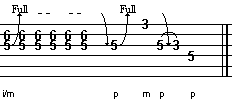
Rock, blues or country in D
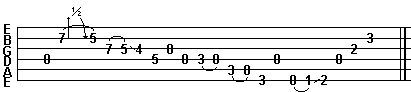
Pull this one off. I play it slower first and then... Key of G.
When going from E7 to A in an up-tempo song you might want to try something like this. From a recording I did of Orange Blossom Special.
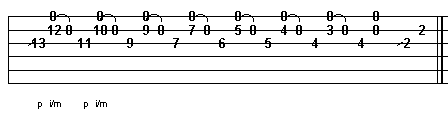
============================ p ALIGN="center">

Good old rhythm guitar in A.

Probably one of the most frequently used patterns ever...

Add an octave on top for a fuller sound.

Another favourite key, G this time. Chord sequence is G, G, C, G, D, (G).

Rock, rockabilly, country, blues, it works anywhere. Now in G. Chords: G, C, D, (G).

No open strings, so this one you can easily move to any key. Use 1st, 3rd and 4th finger on your left hand.

A very effective lead part for the above pattern. I´ve added the rhythm guitar as well.

=============================
Down-home in G.

Country blues turn-around in E.

Intro, turn-around or ending in A using sixths, i e the relationship between the two notes played simultaneously is a musical sixth (minor or major).

Sounds fine over an A, D, A pattern. Swing it!

==================================
Nice sounds in E.

In C. With rhythm guitar.

Pedal steel - like bends, in F. Use 3rd, 4th and 1st finger.

B7 leading to E.

Bending exercise in E. Bend towards the lower E-string.

In A.

Cool sounding A7.

A7

Bending up to A7...

==============================
If you´re in G or Em, this may sound cool.

G

Rock sound in D (and A) using harmonics.


============================
Laid back front porch pickin´ in A...

OK for accompaniment. A to D (to E).

================================
Why I call this banjo style is because I´ve borrowed some techniques
from 5-string banjo. In these examples I´m doing a hammer-on or pull-off on one string
and at the same time I´m picking another string.
This can give a really flowing sound, almost like a banjo roll. In G.

A supercharged G-run.

A variation of the above run, perhaps more folky sounding. 2nd finger: 3rd fret, 6th string; 3rd finger does the pull-off, 1st finger plays the notes on the 2nd fret and the pinky does that last hammer-on.

==================================
Up-tempo country rock in A.

Bluesy sound in A. The thumb holds a steady rhythm alternating between the 5th and 4th string.

More heavy blues. Written in C, but this one is easy to move around. Left hand: 1st finger like a capo over the 8th fret, 3rd finger on the 4th string, use 2nd finger for the pull-offs and hammer-ons and your pinky for that last pull-off.

Here´s some nice swingin´ finger picking. Practice slowly, try
starting with only the alternating thumb, ehh, thing...
I´ve added some rhythm guitar.


=================================
Here´s one in A with some typical fast triplets.

A good pull-off and hammer-on exercise as well.

Rock´n´roll!!! In A.

Here´s some chicken pickin´ in D with a drop-D tuning. That is, tune your 6th string
down a whole step to a low D.

===================================
Very symmetric G scale.

Same notes as above but a different approach. Try also lowering every F# to an F and you´ll get a G mixolydian (G7) scale.

Almost the same as the first one, but with a couple of changes
(raising C to C#) we´re in A mixolydian (A7) mode.

Harp-like sounds in C.

This here rings fine on a D7.

Here´s an ending D major scale lick I use on my song Long Way Home
(although there I play it on an acoustic guitar with a capo on the 2nd fret (E major)).
The last harmonic is produced by touching directly over the 12th fret with the tip of my
right hand index finger, and then plucking the string with my right hand thumb.
Then I raise the pitch of the string a whole step using the E-string´s tuner. (Also with
the right hand.)
Hope that made any sense...

=============================
On this page you´ll find some typical country rock licks, similar ones are often heard in country guitar instrumentals. A great deal of hammer-ons, pull-offs and open strings add to the flowing sound.
In A.

Works fine on a D7.

G7

E7

A7

G7

C7

One bar D7 and then go to G.

Hold the D7 for two bars and then land on that G.

==================================
Popular bend. After you´ve released the first bend, slide down two frets and bend again without picking the string. The chords to use on this one are A - G.

A personal favourite in D. Would be cool to play with a G-bender...

Inspired by Jerry Donahue, here are some "above the nut" bends. Press down on the string above the nut with any old left hand finger (I use my middle finger). Might be hard at first to intonate correctly (might be pretty hard on your finger tips as well, I use .010 strings, ouch..!). The last bend is not above the nut.

==================================